Aurion Mission

Thursday, August 11, 2011

Images and EDS Spectra of Filaments in the Ivuna CI1 Carbonaceous Meteorite.
http://journalofcosmology.com/Life100.html
Figure 1 provides images and Energy Dispersive X-Ray Spectroscopy elemental data for filaments found embedded in the Ivuna CI1 carbonaceous meteorite. Fig. 1.a is a FESEM image of a thin uniseriate filament that is flattened at the terminal end. The filament is cylindrical in the lower portion embedded in the meteorite rock matrix. This small, undulatory filament (diameter 0.7 to 1.0 m) is rich in C, Mg, and S and depleted in N. The filament is only partially encased within a broken and very thin carbonaceous sheath. EDS elemental data is shown for spot 1 on the thin sheath (Fig. 1.b) and for spot 3 on the nearby mineral matrix (Fig. 1.c). The sheath has higher carbon content and biogenic elements N and P are below the 0.5% detection limit of the instrument. Fig. 1.d is a FESEM image of 5m diameter X 25 m long spiral filament Ivuna with white globules that are sulfur-rich as compared with the rest of the filament and the meteorite matrix. A tuft of fine fibrils is visible at the left terminus of the filament and the terminus at the lower right is rounded. Fig. 1.e is a FESEM Backscattered Electron image of an Ivuna filament with sulfur-rich globules S and rounded terminus R that is similar in size and morphology to the giant bacterium “Titanospirillum velox”.

Fig. 1a. Ivuna CI1 meteorite filament (0.8 μm diameter) with dark lines C, partially encased in thin carbon-rich sheath.


Fig 1d. FESEM Backscattered Electron image of an Ivuna filament with N<0.5% and sulfur-rich globules S and rounded terminus R that is similar in size, morphology and internal composition to terrestrial bacteria (See e, below)

Fig 1e. Giant bacterium Titanospirillum velox. Image 1.e Courtesy: Dr. Riccardo Guerrero.

Fig. 1. a. Ivuna CI1 meteorite filament (0.8 μm diameter) with dark lines C, partially encased in thin carbon-rich sheath. b. EDS elemental data of the filament sheath at spot 1 shows typical biogenic elements Nitrogen and Phosphorus (<0.5%) and Carbon (13.1%) enriched as compared with nearby meteorite matrix (C 7.2%) at spot 3; d. FESEM Backscattered Electron image of an Ivuna filament with N<0.5% and sulfur-rich globules S and rounded terminus R that is similar in size, morphology and internal composition to (e.) giant bacterium Titanospirillum velox” with sulfur (S) globules collected from Microcoleus mat of Ebro Delta, Spain. (Scale bar = 5 μm) Ivuna Meteorite Courtesy: Dupont Meteorite Collection, Planetary Studies Foundation; Image 1.e Courtesy: Dr. Riccardo Guerrero. 3.1.1. Interpretation of Images and EDS Data of Ivuna Filaments. The flattened embedded filament shown in Fig. 1.a is interpreted as the permineralized remains of a partially uniseriate, undulatory, ensheathed trichomic prokaryote. The measured diameter (0.7 - 1.0 μm) as determined from the scale bar of this calibrated FESEM image and the detailed morphology of this Ivuna filament is consistent with some of the smaller filamentous cyanobacteria. The dark lines C near the terminus of the sheath are consistent with cross-wall constrictions that are often seen as faint transverse lines in FESEM images obtained with living cyanobacteria. In this image it is possible to see an extremely thin sheath S that is broken and covers only the upper portion of the trichome, which appears to have been completely replaced by infilling minerals.
The size and morphology of this filament is consistent with filaments of the undulatory trichomic filamentous cyanobacteria Spirulina subtilissima (filaments 0.6 - 0.9 μm diameter) and S. laxissima (filaments 0.7 to 0.8 μm diameter). These cyanobacteria have not been reported as possessing a sheath, but the sheath seen in this FESEM image is extremely thin and would be very difficult to discern in by visible light microscopy techniques. There are also very small species of the genus Limnothrix that are undulatory on nature and possess facultative sheaths. However, it shoud be pointed out that there also exist groups of ensheathed filamentous anoxygenic phototrophic bacteria (photosynthetic flexibacteria) possess a thin sheath and are capable of gliding motility. There include filamentous representatives of the bacterial Phylum Chloroflexi. The thermophilic species Chloroflexus aurantiacus has a thin sheath and trichomes as narrow as 0.8 μm. There also other bacterial photoautotrophs that oxidize hydrogen sulfide and deposit it externally as sulfur (e.g., Oscillochloris trichoides) and these trichomic filaments have diameters in the 0.8 to 1.4 μm range.
The length, diameter and spiral configuration and apparent tuft of small filaments at one pole and rounded end at the other along with the internal sulfur globules distributed along the axis of filament (Fig. 1.d) found embedded in a freshly fractured surface of the Ivuna meteorite a complex suite of features.that are very similar to those observed in SEM images of the novel bipolar lophotrichous gram-negative bacterium “Titanospirillum velox” (Fig. 1.e) which was described by Guerrero et al (1999). “Titanospirillum velox” is a very large mat-forming bacterium with 3–5 μm diameter X 20–30 μm long filaments. It was collected from a mud sample beneath a Microcoleus chthonoplastes mat in the Ebro Delta in Tarragona, Spain. “T. velox” swims very rapidly (10 body lengths/sec) with spiral motility, propelled by the lophotrichous tuft of flagella at the cell terminus. The intracellular elemental sulfur storage globules are seen as white spots in this Scanning Electron Microscope image. This extremophile was grown only in mixed culture with other bacteria, which would explain the fact that this genus and species has not yet been accepted as validly published. The Bacteriological Code rules of nomenclature requires that prokaryotic microorganisms must be isolated and grown in pure culture and the designated type stain must be deposited in two international culture collections in two different countries before the genus and species names can be validated (Tindall et al., 2006). The absence of detectable nitrogen content the Ivuna filaments provides evidence that these embedded filaments are indigenous and cannot be dismissed as a modern biological contaminant.
3.2 Images and EDS Spectra of Filaments in the Orgueil CI1 Carbonaceous Meteorite. Figure 2.a. is a low magnification (1000X) Secondary Electron Detector (SED) FESEM image of freshly fractured fragment of the Orgueil CI1 meteorite that is densely populated with several different types of embedded filaments and electron transparent sheaths. Even though the field of view shown of this image is very small (~120 μm wide) a wide variety of diverse filamentous microstructures are present. To facilitate the description, the filaments and sheaths have been numbered, and all numbers are located on the filament at the site where the EDS elemental spot data were recorded. A 2D X-ray elemental map of this region of the Orgueil meteorite is shown in Figure 2.b. The large image in the upper left corner is a Backscatter Electron Detector (BSED) image. The bright spots in this image are high Z elements where clusters and crystallites of magnetite, iron and nickel are concentrated. Other images reveal where relative concentrations Oxygen, Silicon, Magnesium, Sulfur, Iron, Nitrogen; Calcium, and Aluminum are located. The major filaments and sheaths are clearly seen as bright features in the Carbon, Oxygen, Magnesium and Sulfur maps and they appear as dark features in Silicon, Iron, and Nickel due to the relatively higher content of these elements in the underlying Orgueil meteorite rock matrix. In general, the filament and sheath structures are not discernible in the Nitrogen, Phosphorus and Sodium maps, although Filament 1 can be seen in the Nitrogen map. Empty sheath 7 is wrinkled and electron transparent with a relatively high (47%) content of Carbon. This sheath is unusual in that it is one of the few filaments found in the Orgueil meteorite to have detectable levels of Nitrogen (1%) and Phosphorus (0.8%).


Figure 2.a. Hitachi FESEM Secondary Electron Detector image at 1000 X of multiple filaments and sheaths embedded in Orgueil meteorite matrix and b. Backscatter Electron Detector image along with 2-D x-ray maps showing distribution of elements O, C, Si, N, Mg, S, Fe, P, F, Ca, Ni and Cl in filaments for comparison with SED and BSED images. Orgueil Sample Courtesy: Dr. Paul Sipiera, DuPont Meteorite Collection, Planetary Studies Foundation, Chicago Filaments 1 and 2 of Fig. 1.a are observed to have sheaths with longitudinal striations that run the length of the filaments. This is characteristic of multiseriate trichomic prokaryotic filaments in which multiple parallel oriented trichomes are enclosed within a common homogeneous sheath. These filaments are observed to be either attached to or physically embedded in the Orgueil meteorite matrix. The end of filament 1 becomes slightly wider (~10 μm) where it joins the rock matrix and it appears to contain four internal trichomes, each with a diameter ~2.5 μm. Filament 2 is considerable larger (~ 20 μm dia.) and the longitudinal striations suggest it contains ~5 trichomes, each with diameters ~4 μm/trichome. Faint transverse lines orthogonal to the long axis of filament 2 are marked C.
3.1.1 Interpretation and Discussion of Images and EDS Data of the Orgueil Filaments.
The longitudinal striations of the long filament 1 and the shorter, curved filament2 are interpreted as indicating these are multiseriate filaments consisting of a bundle of multiple parallel trichomes encased within a common sheath. If the transverse striations C of filament 2 are interpreted as represent cross-wall constrictions, this would indicate that the internal cells within each trichome are ~ 4 μm in length and hence isodiametric. Consequently, the image of filament 2 is interpreted as composed of trichomes made up of spherical or cylindrical isodiametric cells of 4 μm diameter. This interpretation is consistent with morphotypes of undifferentiated filamentous cyanobacteria of the Order Oscilliatoriacea. There are many genera and species within this very common cyanobacterial order, including the genus Microcoleus Desmazières ex Gomont (Form Genus VIII. Microcoleus Desmazières 1823) (Castenholz, Rippka & Herdman, 2001; Boone et al., 2001). Reproduction within this order occurs by trichome fragmentation and the production of undifferentiated short trichome segments (hormogonia) by binary fission of the cells in one plane at right angles to the long axis of the trichomes. The small solitary uniseriate filaments 3 and 4 may be interpreted as representing members of the genus Trichocoleus Anagnostidis, which was separated from the genus Microcoleus on the basis of cell size and morphology. Filament 4 is a 2 μm diameter hook-shape filament with a narrowed terminus. Several species of the genus Trichocoleus have filaments typically in the 0.5 μm to 2.5 μm diameter range (Wehr and Sheath, 2003, pg. 136). Energy Dispersive X-Ray Spectroscopy (EDS) spot spectral data were obtained on the meteorite rock matrix as well as on all of the numbered filaments and sheaths at positions where the numbers are located in the FESEM image.


Figure 3. Hitachi FESEM images at 1500X of a. collapsed filament 9 and helical coiled empty sheath 10 and b. 6000X image of filament 11 showing hook and calyptra or conical apical cell. c. EDS spot spectra show elemental compositions c. of loose sheath 10 (C 29.1%; N=0.7%) and d. sheath 11 (C 47.8%; N<0.5%). Figure 3.a is a1500X FESEM SED images of the collapsed Filament 9 and the hollow, flattened, twisted and folded sheath 10. Sheath 10 is 4.6 μm in diameter and it is folded at the top where the EDS spectra were taken. The flattened portion of Sheath 10 forms a spiral coil near the base where it is attached to the meteorite matrix. This is very similar to helical coiled sheath of Phormidium stagninum shown in the illustration at http://www.cyanodb.cz//Phormidium/Phormidium.jpg illustration. This type of flattened, coiled hollow sheath is often seen in other species of filamentous cyanobacteria and hence does not constitute a unique diagnostic feature. Figure 3.b. provides a higher magnification (6000X) image of Sheath 11, which is visible at the top of Fig. 2.a. Sheath 11 is a tapered and hooked form with a conical terminal cell or calyptra at the apex. It is 8.5 μm wide where it emerges from the rock matrix and it tapers to 1.5 μm diameter just after the sharp hook. Figure 3.c. is a 10 keV EDS spectrum taken at spot 10 in the fold of Sheath 10 and shows detection of low, but measurable level of Nitrogen (0.7%) and Phosphorus (0.3%) and higher levels of Iron (19%) and Silicon (14%), which are probably from the meteorite matrix beneath the this, electron transparent carbon-rich sheath. The EDS spectrum at 5 keV for spot 11 on sheath 11 as shown in (Fig. 3.d) reveals this flattened sheath to be highly carbonized (48% C atomic), This small filament appears as a bright feature in the carbon map of (Fig. 2.b) and as a dark shadow in the Magnesium and Sulfur maps as it crosses in front of large filaments more heavily mineralized with magnesium sulfate. Filament 11 is also sulfur-rich (21% S), but has Nitrogen below the level of detectability (< ~0.5%).
3.2 Orgueil Filaments with Differentiated Heterocysts. Several genera of the cyanobacterial orders Nostocales and Stigonometales use specialized cells known as “heterocysts” to fix atmospheric nitrogen. Nitrogen fixation is an unambiguously biological process that is absolutely crucial to all life on Earth. Although nitrogen comprises almost 78% of our atmosphere, it is completely useless to life in its relatively inert molecular form. The biological process of nitrogen fixation occurs by the reduction of gaseous nitrogen molecules (N2) into ammonia, nitrates, or nitrogen dioxide. Many species of several genera of cyanobacteria (e.g., Anabaena, Nostoc, Calothrix, Rivularia, Scytonema, etc.) use highly specialized cells for nitrogen fixation by encapsulating the nitrogenase enzyme in thick-walled protective heterocysts.
Cyanobacteria play the key role in nitrogen fixation on Earth and many genera and species of are capable of diazotrophic growth and nitrogen metabolism. Nitrogen fixation occurs via the nitrogenase enzyme with some other proteins involved in this complex biological process. Since the activity of the nitrogenase enzyme is inhibited by oxygen the enzyme must be protected. In many species it is contained within the thick-walled specialized nitrogen-fixing cells called “heterocysts.” The heterocysts have very distinctive, thick, hyaline, refractive walls that provide well-protected centers in which the nitrogenase enzyme, which is inactivated by oxygen, can carry out its required activity.
Heterocysts of cyanobacteria produce three additional cell walls, including one with glycolipids that form a hydrophobic barrier to oxygen. This is crucial since cyanobacteria are aquatic photoautrophs that evolve oxygen during their photosynthesis. To provide additional protection, the cyanobacterial heterocysts lack photosystem II (Donze et al., 1972). Therefore the heterocysts produce no oxygen and they also up-regulate glycolytic enzymes and produce proteins that scavenge any remaining oxygen. As early as 1949, Fogg recognized that heterocysts are formed from the vegetative cells of the cyanobacteria when the concentration of ammonia or its derivative falls below a critical level and by 1968 it was becoming clear that the heterocysts were the site of nitrogen fixation (Fogg, 1949; Fay et al., 1968; Stewart et al., 1969). Heterocysts are found in cyanobacteria of the Order Nostocales and the Order Stigonematales, but they are never found in any of the genera or species of the other three orders (Chroococcales, Oscillatoriales, or Pleurocapsales). Furthermore, heterocysts have not been observed in any the known filamentous sulfur bacteria of any other trichomic prokaryotes. Consequently, the detection of heterocysts provides clear and convincing evidence that the filaments are not only unambiguously biological but that they belong to one of these two orders of cyanobacteria rather than trichomic ensheathed sulfur bacteria or any other group of filamentous trichomic prokaryotes. The presence or absence and the location and configuration of heterocysts has for a long time been a critical diagnostic tool for the recognition and classification of many important taxa of cyanobacteria. The FESEM image of the mineralized remains of polarized filaments interpreted as morphotypes of the cyanobacterium Calothrix spp. found embedded in the Orgueil CI1 carbonaceous meteorite. Several tapering filaments (diameter ~ 1 to 2.5 μm ) and recognizable enlarged cells are seen in close proximity to each other with the smooth basal heterocyst attached to the meteorite matrix (Fig. 4.a). For comparison, a FESEM image of a living Calothrix sp. with a diameter ~ 0.8 μm and basal heterocyst from White River, Washington is shown in Fig. 4.b.


Figure 4.a. FESEM image of permineralized remains in the Orgueil meteorite of polarized tapered filaments (diameter ~ 1 to 2.5 μm) with recognizable heterocysts interpreted as morphotypes of the cyanobacterium Calothrix spp. and. b. living filament of Calothrix sp. with a diameter ~ 0.8 μ and a basal heterocyst from the White River, Washington.


Figure 5. Long sinuous, helical coiled and polarized filament with conical apex (<1.3 μm) and terminal heterocyst similar to cyanobacterium Cylindrospermopsis sp. in the Orgueil meteorite and b. short embedded filament in Orgueil compared with c. living Tolypothrix distorta grown in pure culture at the NASA/NSSTC Astrobiology Laboratory. Orgueil Meteorite Sample Courtesy: Dr. Martine Rossignol-Strick, Musée Nationale d’Histoire Naturelle, Paris Figure 5.a is a Hitachi S4100 FESEM image of helical coiled polarized filament in Orgueil CI1 carbonaceous meteorite. The filament has a conical apex (<1.3 μm)at left end and a bulbous (2.3 μm diameter) heterocyst is seen at the other terminus. This filament has size and morphological characteristics of morphotypes of cyanobacteria of species of the genus Cylindrospermopsis. Fig. 5.b. is an image of a 2.5 μm diameter filament embedded in Orgueil. This filament has a 4.7 μm diameter bulbous terminal heterocyst and is interpreted as a morphotype of cyanobacteria of the genus Tolypothrix. Fig. 5.c is an image of a morphotype of living Nostocalean cyanobacterium Tolypothrix distorta shown for comparison.
Although many modern cyanobacteria are resistant to desiccation, they do not carry out active growth and mat building when they are in a dried state. However, it has been known since 1864 that the Orgueil meteorite is a microregolith breccia, comprised of minute particulates cemented together by water-soluble salts that are readily destroyed by exposure to liquid water. Therefore, it is suggested that none of the Orgueil samples could have ever been submerged in pools of liquid water needed to sustain the growth of large photoautotrophic cyanobacteria and required for the formation of benthic cyanobacterial mats since the meteorite arrived on Earth. Many of the filaments shown in the figures are clearly embedded in the meteorite rock matrix. Consequently, it is concluded that the Orgueil filaments cannot logically be interpreted as representing filamentous cyanobacteria that invaded the meteorite after its arrival. They are therefore interpreted as the indigenous remains of microfossils that were present in the meteorite rock matrix when the meteorite entered the Earth’s atmosphere. EDS elemental analyses carried out on the meteorite rock matrix and on living and fossil cyanobacteria and old and ancient biological materials have shown that the Orgueil filaments have elemental compositions that reflect the composition of the Orgueil meteorite matrix but that are very different from living and old microorganisms and biological filaments. Recently dead cyanobacteria and living cyanobacteria and other modern extremophiles are usually damaged by exposure to the focused FESEM electron beam during EDS analysis of small spots. This beam damage behavior was not observed in the Orgueil filaments or in Devonian, Cambrian, or Archaean fossils investigated. The C/N and C/S ratios of the Orgueil filaments are similar to fossilized materials and kerogens but very different from living biological matter, providing further evidence that the Orgueil filaments are not modern biological contaminants.
Comets as Parent Bodies of CI1 Carbonaceous Meteorites.
http://journalofcosmology.com/Life100.html
The CI1 carbonaceous meteorites are jet-black stones that contain indigenous extraterrestrial water. The albedo of the Orgueil meteorite is extremely low (~0.05) and comparable to that of the very dark C-type asteroids and the nuclei of comets. This is blacker than asphalt which has an albedo of ~ 0.07. The European Space Agency Halley Multicolor Camera aboard the Giotto Spacecraft obtained images at the closest approach (00:03:01.84 UT on March 14, 1986) at a distance of 596 km from the centre of the nucleus revealing detailed topographic features on the black (albedo 0.04) surface and jets Lamarre et al. (1986) reported that IKS-Vega data indicated the temperature of nucleus of comet Halley was 420 K +/- 60K at 0.8 A.U which was consistent with “a thin layer of porous black material covering the comet nucleus.” The Deep Space 1 spacecraft found the 8 km long nucleus of Comet 19P/Borrelly to be very hot (~345 K) with prominent jets aligned with the orientation of the rotation axis of the nucleus and albedo of 0.01 to 0.03 (Soderbloom et al. 2002). Ices of water, carbon dioxide, methane and other volatiles in the cold nucleus in proximity to the hot crust would melt and then boil to produce high pressure beneath the crust if gas is released faster than it can escape through the porous crust. In regions where the pressure exceeds the strength of the crust, localized failure of portions of the crust could result in explosive release of the gas giving rise to the observed flaring of comets and the dramatic jets.
Once a comet enters the inner solar system, it becomes hot from solar radiation on the black nucleus and loses mass rapidly. The European Space Agency Infrared Space Observatory (ISO) showed that water was the primary volatile (75-80 %) of the 40-50 km diameter nucleus of Comet Hale-Bopp. Minor volatile fractions detected (CH4, NH3 and H2CO) could have come from clathrates (H2O ice with simple gasses like CO2 and NH3 in a stable lattice structure) or result from atmospheric chemistry. ISO found that Hale-Bopp released water vapor, carbon monoxide and carbon dioxide at a rate of 2 x 10⁹ kg/sec and detected olivine in the dust. Olivine is commonly encountered in meteorites. As comets lose ices they develop an inert outer crust from the less volatile material. The nuclei of comets are extremely complex – they exhibit rugged terrain, smooth rolling plains, deep fractures and are composed of very dark material. This black crust becomes very hot while the comet is in the inner regions of the Solar System.


Figure 7.a. Deep Space 1 image of Comet P/Borrelly with jets of gas and dust; b. Deep Impact image of nucleus of Comet 9P/Temple 1 shows regions of exposed water ice and c. temperature map from Deep Impact IR spectra d. Giotto Halley Multicolor Camera (HMC) image showing jets emanating from of the 0.04 albedo nucleus of Comet P/Halley Image Courtesy: Max Plank Institute for Solar System Research http://www.mps.mpg.de/en/projekte/giotto/hmc/; e. Deep Impact spacecraft extended mission (EPOXI) image of the nucleus of comet Hartley 2 showing jets of dust and gas. Image Courtesy: NASA/JPL UMD). Figure 7.a. is a NASA Deep Space 1 spacecraft composite false color image showing geyser-like jets erupting from the long prolate nucleus (8 km) of comet 19P/Borrelly on Sept. 22, 2001. (The colors indicate three orders of magnitude in light level (red is 1/10, blue 1/100 and purple 1/1000 the intensity of the comet nucleus). The red bumps on the nucleus are real and show where the main jet resolves into three distinct narrow jets coming from distinct sources on the comet nucleus. These narrow jets are entirely consistent with the hypothesis that internal pressures generated by steam produced by melting of internal ices which then boil into gases as they are vaporized as heat conducts through hot crust. The NASA Deep Impact probe obtained the valuable data about the nature of comets as it approached and when the impactor collided with the nucleus of comet 9/P Temple 1 on July 4, 2005. Fig. 7.b is a Deep Impact image of the nucleus of comet Temple 1. The regions shown in blue are where exposed deposits of water ice that were detected on the surface of the comet nucleus Sunshine et al. (2005). These water ice regions ere observed to be ~30% brighter than the surrounding areas and probably were exposed when portions of the black crust was blown off into space by the explosive eruptions such as were recorded in a video by the spacecraft. The Deep Impact measurements of the temperature profile of comet P/Temple 1 nucleus at 1.5 AU is shown in Figure 7.c. Even as far away from the Sun as Mars the jet-black comet nucleus reaches temperatures as high as 330 K (57 oC). Furthermore, the lowest temperatures measured on the crust were ~ 280 K (7 oC) which is slightly above the temperature at which water ice changes from solid to liquid phase. Prior to the impact, the ambient outgassing of Temple 1 was ~6x1027 molecules/s of water. However, the free sublimation of ice calculated above (~200 K) was only ~4.5 x 10²¹ molecules/m2/s indicating that the ambient outgassing had significant subsurface sources. The Deep Impact spacecraft also observed numerous events of flaring of the nucleus and eruption of geyser-like jets as the comet was approached and before the collision of the impactor. On November 4, 2010, the NASA EPOXI extended mission of the Deep Impact Spacecraft passed within 435 miles of the 2.2 km long nucleus of comet Hartley 2 and revealed bright jets of carbon dioxide gas and dust.
These observations of comets are consistent with the hypothesis that the comet crust impedes the flow of gasses such that pressures develop as ices melt and vaporize in pockets and cavities beneath the crust. This provides the pressures needed to allow water to transition from the solid to the liquid state and then into the gaseous state. This would create micro-niches with pools of liquid water trapped within pockets in rock and ice, very much analogous to the cryoconite and ice bubble ecosystems contained psychrophilic microbial extremophiles such as those described from the glaciers and frozen Pleistocene thermokarst ponds of Alaska and Siberia and the glaciers and perennially ice covered lakes of the Schirmacher Oasis and Lake Untersee in East Antarctica (Hoover, 2008; Hoover and Pikuta, 2010; Pikuta et al. 2005). If gas is produced faster than it can escape through the porous crust, it could high pressures resulting in localized failure of weaker portions of the crust and the violent eruption into space of carbon dioxide, water vapor and chunks of crust and particles of ice and dust propelled into space and directed into the dust tail of the comet. These dust particulates could give rise to meteor showers as the comet passes through the tail. From time to time, larger chunks of the ejected may survive passage through the Earth’s atmosphere and this could be the link between comets and the CI1 (and possibly the CM2) carbonaceous meteorites. The fact that the CI1 meteorites contain minerals that were extensively altered by liquid water on the parent body and that the stones have been found to contain a large amount of indigenous extraterrestrial water clearly establishes that their parent bodies were most likely comets or water-bearing asteroids. It is now well known that the black nuclei of comets get very hot (significantly above >273 K where water ice melts) as they approach the Sun.
Gounelle et al. (2006) used the eyewitness accounts to compute the atmospheric trajectory and orbit of the Orgueil meteoroid and concluded that the orbital plane was close to the ecliptic and that entry into the atmosphere took place at a height of approximately 70 km and an angle of ~20°. Their calculations indicated the meteoroid terminal height was ~20 km and the pre-atmospheric velocity was > 17.8 km/sec. They found the aphelion to be 5.2 AU (the semi-major axis of orbit of Jupiter) and perihelion ~0.87 AU, which is just inside the Earth's orbit as would be expected for an Earth-crossing meteorite. This calculated orbit suggests the Apollo Asteroids and the Jupiter-family of comets are likely candidates for the Orgueil parent body include (although Halley-type comets are not excluded).
The cosmochemistry data for a cometary parent body is entirely consistent with the composition and characteristics of the CI1 meteorites. This suggestion that the parent body of the CI1 carbonaceous meteorites were possibly comets is significant with regard to possible existence of indigenous microfossils in the Alais, Ivuna and Orgueil meteorites. From the extensive evidence of aqueous alteration on the Orgueil parent body and the presence of indigenous water in the Orgueil meteorite it is clear that the parent body was either a water-bearing asteroid or a comet. However the Giotto and Vega observations of Halley and the Deep Impact Observations of the nucleus of 9P/Temple-1 have clearly established that these bodies get very hot as they enter the inner regions of the Solar System. It is now clear that any water bearing asteroid with an albedo of the Orgueil meteorite would reach a temperature above 100 C at 1AU. At these temperatures, water ice and other volatiles would be converted to liquid water, steam, and produce an expanding cloud of gas and expelled particulates. Any planetessimal orbiting the Sun and possessing a gaseous envelope and dust tail is traditionally refered to as “comet” rather than an asteroid, and therefore it seems logical that comets represent the most probable parent bodies for these water rich, black meteorites that travel in trajectories that cross the orbit of planet Earth.
4.6 Role of Comets and Carbonaceous Meteorites in the Origin and Evolution of the Earth’s Atmosphere, Hydrosphere, and Biosphere The relationship of comets with carbonaceous meteorites and their role in the origin and evolution of the atmosphere, hydrosphere, and biosphere of Earth has become better understood during the past few decades. The cratered surface of the moon provides clear evidence of the intense Hadean bombardment of the inner planets and moons by comets, asteroids and meteorites during the early history of the Solar System. Watson and Harrison (2005) interpreted the crystallization temperatures of 4.4 Ga Zircons from Western Australia as providing evidence that liquid water oceans were present on the early Earth within 200 million years of the formation of the Solar System. It has recently become more widely recognized that comets played a crucial role in the formation of the atmosphere and oceans of early Earth during the Hadean bombardment (Delsemme, 1997; Steel, 1998; Owen, 1997).
In 1978, Sill and Wilkening proposed that comets may have delivered life-critical biogenic elements carbon and nitrogen trapped within clathrate hydrates in their icy nuclei. In the same year, Hoyle and Wickramasinghe (1978, 1981, 1982, 1985) have proposed that comets delivered not only water, biogenic elements and complex organic chemicals to the surface of planet Earth, but that they also delivered intact and viable microorganisms. The detection of microfossils of cyanobacteria and other filamentous trichomic prokaryotes in the CI1 carbonaceous meteorites (which are likely cometary crustal remnants) may be interpreted as direct observational data in support of the Hoyle/Wickramasinghe Hypothesis (Wickramasinghe 2011) of the role of comets in the exogenous origin of terrestrial life.

Eberhardt et al. (1987) measured the deuterium/hydrogen ratios in the water of comet P/Halley. Delsemme (1998) found that that the D/H ratio of the water molecules of comets Halley, Hale–Bopp and Hyakutake were consistent with a cometary origin of the oceans. Dauphas et al., (2000) interpreted the deuterium/hydrogen ratios indicate that the delivery of water and ice to the early Earth during the late Hadean heavy bombardment by comets, asteroids and meteorites helped to cool the Earth’s crust and form the early oceans. Table V shows data extracted from the Robert et al. (2000) compilation of Deuterium/Hydrogen ratios of selected components of the Cosmos.
When these bodies are grouped in accordance with their D/H ratio it is easily seen that the telluric inner planets and the LL3 (stony) and SNC (Mars) meteorites have high (~500-16,000) ratios and the gas giants, protosolar nebula, ISM and Galaxies are very low (~15-65). The D/H ratios of the comets (~290-330) and carbonaceous meteorites (~180-370) are much closer to that of Earth (~149) and support the hypothesis that they may have made significant contributions to the formation of the oceans of our planet. It is interesting that the D/H ratios of comets are very similar to the ratios measured in the kerogen, amino acids and carboxylic acids of the Orgueil (CI) and other (CM, CV, and CR) carbonaceous meteorites. This supports the view that although stony meteorites are most probably derived from rocky asteroids, the carbonaceous meteorites most probably are derived from water-bearing asteroids or the nuclei of comets. The 30 m diameter fast-spinning carbonaceous asteroid 1998 KY26 that was discovered on June 2, 1998 has been found to contain 10-20% water. However, the small carbonaceous, water-rich asteroid 1998 KY26 also has color and radar reflectivity similar to carbonaceous meteorites and it may be a spent comet. Near IR observations indicated the presence of crystalline water ice and ammonia hydrate on the large Kuiper Belt object (50000) Quaoar with resurfacing suggesting cryovolcanic outgassing. The Cassini/Huygens spacecraft has recently obtained data indicating that a vast liquid water ocean may also exist beneath the thick frozen crust of Titan. Cassini/Huygens has also detected evidence for cryovolcanic water-ice geysers on Titan and Saturn’s moon Enceladus.

The Discovery of Alien Extra-Terrestrial Life: The Cosmic Origins of Life [Hardcover]

Richard Hoover (Author), C. N. Wickramasinghe (Author), R. Joseph (Author), Rudy Schild (Author)

http://www.amazon.com/dp/0982955294?tag=cosmology07-20&camp=14573&creative=327641&linkCode=as1&creativeASIN=0982955235&adid=1QVQKFB4AASR58KQTQN0&

Book Description

March 22, 2011
We Are Not Alone! In 2007 NASA approved for publication the discovery of microfossils in three meteors. After years and months of careful preparation and peer review, this landmark paper was published and on March 5, 2011, and the world was stunned to learn of the discovery of ancient extraterrestrial life; fossils of Cyanobacteria in meteors older than Earth.

The discovery of Cyanobacteria is of particular importance. It is Cyanobacteria which helped create the oxygen atmosphere of this planet. Oxygen interacts with sunlight to produce radiation shielding ozone. Cyanobacteria also secrete calcium when creating their mats, and this calcium made it possible for shells, bones, and the skeletal system to evolve.

Cyanobacteria are a hardy species, and can live in extreme  environments. Therefore, if Cyanobacteria came from and are deposited on Earthlike planets, it can be assumed they had or would also biologically engineer these alien worlds, providing them with an oxygen atmosphere and flooding the environment with calcium, thereby making it possible for life to evolve into intelligent species, similar to or completely different from, and possibly more intelligent than woman and man.

We are not alone.

In 1584, Giordano Bruno published “Of Infinity, the Universe, and the World” and wrote ”There are innumerable suns and an infinite number of planets which circle around their suns as our seven planets circle around our Sun”.  According to Bruno, we are unable to see these planets and suns” because of their great distance or small mass. ”On February 19, 1600 Bruno was tortured and burned at the stake by the Inquisition for publishing these claims which contradicted established ”scientific” dogma.

The publication of Richard Hoover's paradigm shattering discovery of microfossils within carbonaceous meteorites, unleashed an ugly storm of violent, histrionic invective not seen since the Middle Ages when they burned scientists for making discoveries that threatened the established order.

This is The Book, they do not want you to read.

We are not alone. That landmark paper, by Richard Hoover of NASA, is the lead chapter and is accompanied by chapters featuring critical commentary written by top scientists throughout the world, as well as speculation about the implications of life, its origins, and evolution throughout the cosmos. Consider the implications:

<!--[if !supportLists]-->1)    <!--[endif]-->There is evidence of biological activity in this planet's oldest rocks, which means life was present on Earth from the very beginning.

2) Two separate teams of scientists have determined, based on a genomic analysis, that DNAbased life has a genetic ancestry leading backwards in time over 10 billion years, which is twice the age of Earth.

3) Dozens of studies have proven conclusively that microbes can survive the ejection from and crash landing onto a planet surface and a journey through space.

4) The implications are that life on Earth, came from other planets, and these first life forms included cyanobacteria.

The implications are staggering. It can be assumed life is everywhere and has a cosmic ancestry extending backwards in time, interminably into the long ago, and that intelligent life has evolved on countless Earth-like planets. Life must have evolved on innumerable worlds which are much older than Earth, evolving beyond the humans of Earth before our planet was even formed. Great extra-terrestrial
technologically advanced civilizations likely ring the cosmos, including on planets billions of years older than our own.

All this and more is included in the chapters of this amazing book:

Our ancient ancestors journeyed here from the stars.


FBI memo: Roswell saucers were real

Cylon Raider or algae? Swedish booze hunters may have made the UFO find of the century

Baltic UFO
Team Ocean Explorer said this image shows 300m "drag marks". Picture courtesy Ocean Explorer/Peter Lindberg Source: Supplied


Read more: http://www.news.com.au/technology/sci-tech/cylon-raider-or-algae-swedish-booze-hunters-may-have-made-the-ufo-find-of-the-century/story-fn5fsgyc-1226098833887#ixzz1UiObJJn2

Read more: http://www.news.com.au/technology/sci-tech/cylon-raider-or-algae-swedish-booze-hunters-may-have-made-the-ufo-find-of-the-century/story-fn5fsgyc-1226098833887#ixzz1UiNtM0i4

Ghost city appears above Xin'an River


Mirage city

Ghost city appears above Xin'an River

Tall buildings miraculously appeared on the normally clear Xin'an River. Picture: ITN Source: Supplied
Mirage city
The mirage appeared after heavy rainfall. Picture: ITN Source: Supplied
1 of 2
  • City appears over Chinese river
  • Residents think it's a "vortex"
  • Scientists say it's a great mirage
IT looks like any other city skyline with skyscrapers, a few mountains and trees - except it isn't real.
The giant mirage appeared across the skyline near in East China earlier this month after heavy rainfall and humid conditions along the Xin’an River.
As mist settled over the river at dusk, tall buildings appeared to rise from nowhere, leading residents in nearby Huanshan City to speculate that the vision may be a "vortex" to a lost civilisation.
Scroll down to see amazing footage of the ghost city
"It's really amazing, it looks like a scene in a movie, in a fairlyland," one resident told UK news channel ITN.
The mysterious city had vanished just as quickly as it had come.
Scientists have quashed the vortex theory and, as per usual, have a simple explanation for the incredible sight.
They believe it may have been a mirage, caused when moisture in the air becomes warmer than the temperature of the water below.
When rays of sunlight cross from the colder air into the warmer air they are refracted or bent – creating a reflection in the air that looks similar to a reflection in water.
It's a common sight for many travellers on Australian roads. But we Australians tend to see puddles of water that disappear when you get close, not entire cities floating on rivers.


Australian meteorite behind 'space DNA' discovery
Meteorite DNA
Researchers have discovered some of the building blocks of DNA found on meteorites actually came from space. Picture: NASA Source: Supplied
A METEORITE which crashed in Australia more than four decades ago has led to a major new discovery about the nature of humankind.
Writers and filmmakers have for decades hypothesised about little green men "out there" somewhere, but it turns out alien life may actually exist closer to home.
Much, much closer.
NASA overnight said researchers had discovered that some of the building blocks of DNA found in meteorites were actually created in space — lending weight to the idea that life on Earth began with materials from the cosmos.
Scientists were previously unsure if the meteorites had brought the materials with them, or been "contaminated" by humans or animals after landing.
Dr Michael Callahan of the agency's Goddard Space Flight Centre said it was the famous Murchison meteorite which led to the discovery.
"There's a meteorite that landed in 1969 in Murchison in Victoria. It's actually the most well studied meteorite for organic molecules," he told news.com.au.
"It's kind of like the benchmark meteorite that people look at for organic molecules."
To prove the meteorites hadn't been contaminated, Dr Callahan and his team looked at soil and ice samples from near the Murchison crash site and another in Antarctica.
"We compared terrestrial samples to our meteorite result and they looked very different," he said.
"It's kind of given us another clue that these compounds looked indigenous to the meteorite and it’s not something like contamination."
Dr Callahan said he was stunned to have stumbled upon another missing piece of the puzzle of life's origins.
"I was shocked," he said.
"I was very surprised. I didn't believe it at first. I didn't think my result was real.
"I took a lot of time to verify the results, through lots of control samples and state of the art analysis. It took me about a year to convince myself that was I was looking was real, but it was."
Dr Callahan's discovery has led some to question whether other planets might contain the same building blocks for life as those that exist on Earth, however the scientist said it was not a given.
"The likelihood of life elsewhere, the possibility does increase a little bit," he said.
"(However) it takes a lot of steps to go from building blocks to life."

Wednesday, August 10, 2011

Comet Tempel 1 showed evidence of relic frozen lakes and clay indicative of early contact with liquid water
http://www.springerimages.com/Images/HumanitiesArts/1-10.1007_978-90-481-9748-4_21-2
Comet Tempel 1 showed evidence of relic frozen lakes and clay indicative of early contact with liquid water
Recent studies of comet Tempel 1 (Figure 3) have shown evidence of organic molecules, clay particles as well as liquid water, providing an ideal setting for the operation of the “clay theory” of the origin of life (Cairns-Smith, 1966; Napier et al., 2007).
A structure in the Murchison meteorite compared with living cyanobacteria (Hoover, 2005)
http://www.springerimages.com/Images/HumanitiesArts/1-10.1007_978-90-481-9748-4_21-7
A structure in the Murchison meteorite compared with living cyanobacteria (Hoover, 2005)
The Ball-of-Light Particle Model predicts a Pulsar is a ball-of-light that has a very powerful electromagnetic wave sweeping across its surface. The pulsar has no outer envelope of material such as the outer plasma envelope of a normal star.
http://www.grandunification.com/hypertext/Pulsars.html
If the Ball-of-Light Particle Model is correct, then the magnetic field orientation of the top and bottom hemispheres in the above graphic should be curling in opposite directions. If the traditional theory of pulsars is correct, then the magnetic fields in the above graphic should be oriented in the same direction. A recent image of the Egg Nebula from the Hubble Space Telescope is shown below.

Notice how the light is polarized in opposite directions. This matches the Ball-of-Light Particle Model, not traditional theory.
See also, Thermal vs. Nonthermal Radiation, Nonthermal Radiation from Pulsars)

Scattergun rays - Egg Nebula

   
http://www.cosmicastronomy.com/egg.htm#scattergun

Visble Gravity Waves in Space

http://www.cosmicastronomy.com/edge.htm
Web site/display/designs/image enhancements - Greydon Moore
World's largest cosmic teaching site - Ottawa 2001/2004    


WAVES, WAVES, AND MORE WAVES      

Astronomers to Use Pulsars to Detect Gravitational Waves Created by Super-Massive Black Holes

6a00d8341bf7f753ef0134850fc301970c-320wi Last year, an international team of scientists discovered a promising way to fine-tune pulsars into the best precision time-pieces in the Universe and provide astronomers with a new tool to study the powerful gravitational forces that shaped the universe.

Pulsars--incredibly fast spinning collapsed stars--have been studied in great detail since their discovery in 1967.

Pulsars rank at or near the top of freaky phenomena found in our Universe. In the early 1930s, California Institute of Technology astrophysicist, Fred Zwicky, an immigrant from Bulgaria, focused his attention on a question that had long troubled astronomers: the appearance of random, unexplained points of light.

It occurred to Zwicky that if a star collapsed to the sort of density found in the core of atoms, the result would be an unimaginably compacted core: atoms would be crushed together with their electrons squeezed into the nucleus, forming neutrons and a neutron star, with a core so dense that a single spoonful would weigh 200 billion pounds. But there's more, Zwicky  concluded: with the collapse of the star there would be  huge amounts of leftover energy that would result in a massive explosion,  the biggest in the known universe that we called today supernovas.
Continue reading " Astronomers to Use Pulsars to Detect Gravitational Waves Created by Super-Massive Black Holes" »

Orion Anomalies -- Gravity waves?

http://www.cosmicastronomy.com/other.htm#orion
NOAO IMAGE OF ORION IS EXAMPLED - GRAVITIC RILLS FOUND


A very
'motor' formation
appears in enhancements, and
rills in moire patterns dominate the image

Enhanced, and rills noticed by Greydon Moore


Closeup presents sharper details when the images are focused together


These
if gravity
waves are very high
frequency, short length,
thin, narrow cross sections, banded
closely together, like a piping steam kettle
whistle compared to the resounding bassoon low notes
of gravity waves around M101 and the rumbling bottom pedal
of Zarathustra's church organ for the giant, thick, long, gravity
waves in the Bullseye at Andromeda. These gravity waves in Orion are
perhaps associated with the strong impact vibration structure to
the left of the waves, raising the question as to whether
they contribute to the impact vibration structure
or are caused by it, if so, how come in
the field to the right and not
somewhere else

Gravitational Waves
At the NASA Goddard Space Flight Center's Laboratory for High Energy Astrophysics, a new research group is devoting their collective effort to understanding and detecting gravitational waves. Scientists are creating computer programs to model gravitational waves that will be detected by a new NASA satellite, called LISA.


http://imagine.gsfc.nasa.gov/docs/features/topics/gwaves/gwaves.html

General Relativity

In 1916, Albert Einstein published his famous Theory of General Relativity. His theory describes how space-time is affected by mass. We can think of space-time as a fabric that bends or curves when we place an object on it. Keep in mind that the 2-dimensional fabric analogy is just a model we use to represent what is actually 4-dimensional space-time (the normal three dimensions of space, plus a fourth dimension of time).

artist's concept of the Sun causing a curve in the sheet of spacetime
Illustration showing the effect the mass of the Sun has on space-time.

Imagine pulling a sheet taut and placing a bowling ball in the center of it; you will notice that the ball produces a curve in the sheet. The curve is weak far away from the ball, and steeper near the ball. In fact, the sheet is a bit stretched in that area near the ball, as well. This situation describes the curvature of space-time, and how it is affected by mass. Near a mass, space-time curves more drastically and stretches. Near a very large mass, the 'dent' in space-time is very deep, and the stretches are near the breaking point. This means that since space-time stretches near a mass, not only is space stretched out, but so is time. What do you think would happen if you put something extremely heavy on the sheet? Obviously, you might have a hard time holding the sheet up, but imagine that you had some help from Superman. The heavy object would break through the sheet! In space, this is what we call a black hole. The mass is so large that anything that comes near it (even light) falls through the hole, and is never able to return.

So What is a Gravitational Wave?

artist's concept of two black holes orbiting each other and
emitting gravitational waves
Illustration showing two black holes orbiting each other and emitting gravitational waves.


Most scientists describe gravitational waves as "ripples in space-time." Just like a boat sailing through the ocean produces waves in the water, moving masses like stars or black holes produce gravitational waves in the fabric of space-time. A more massive moving object will produce more powerful waves, and objects that move very quickly will produce more waves over a certain time period.

Where Do Gravitational Waves Come From?

Gravitational waves are usually produced in an interaction between two or more compact masses. Such interactions include the binary orbit of two black holes, a merge of two galaxies, or two neutron stars orbiting each other. As the black holes, stars, or galaxies orbit each other, they send out waves of "gravitational radiation" that reach the Earth, However, once the waves do get to the Earth, they are extremely weak. This is because gravitational waves, like water waves, decrease in strength as they move away from the source. Even though they are weak, the waves can travel unobstructed within the 'fabric' of space-time. This how they are able to reach the Earth and provide us with information that light cannot give.


How Can We Detect Gravitational Waves?

artist concept of LISA
Artist's concept of LISA.


Since the waves are so weak when they reach us, scientists had to use their imaginations to come up with instruments sensitive enough to detect such slight variations in space-time. Interferometry is the technique astronomers use to detect small stretches in space-time. The technique requires test masses to be set at a large distance from each other. Lasers make continuous measurements of the distance between each of the test masses. The masses are free to move so that when a gravitational wave passes, the distance between the masses will fluctuate. That is, space-time will be stretched. The lasers record this variation in distance, and the scientists know that a wave has passed. The greater the distance between the masses, the more sensitive the lasers are to small fluctuations. There are currently several ground-based detectors in operation or under construction, including LIGO (USA), VIRGO (Italy/France), GEO (Germany/Great Britain), and TAMA (Japan). The space-based observatory LISA is scheduled to launch in 2011.
In order to detect gravitational waves, it is necessary to create a model of what the incoming waveform might look like. Since there are so many sources at a given time, scientists must create computer models of gravitational waves so they know what to look for in what seems like a huge mess of data. Dr. Joan Centrella, a theoretical astrophysicist at NASA's Goddard Space Flight Center, leads a team of scientists who create these models. Currently, the group is working on computer models of massive black hole coalescences that occur when the black holes at the centers of two colliding galaxies spiral into each other. "Once we have the models for this system, we can just substitute different masses for the black holes. That way, several models can be made from one program," says Dr. Centrella.

What Will We Learn From the Detectors?

Gravitational waves will help physicists and astronomers to understand some of the most fundamental laws of physics. They will also tell us about the dynamics of large-scale events in the Universe like the death of stars, and the birth of black holes. With LISA, scientists will be able to probe through space and time, to observe the Universe just a fraction of a second after the Big Bang. Using this information, we may be able to learn more about how the Universe began and evolved as well as what might be in store for the future.

See what else LISA could tell us about!.


Publication Date: August 2003

Tuesday, August 9, 2011

If ET phones, we're listening again -- thanks to you. 
Astronomers at the cash-strapped SETI Institute are poised to resume the quest for extraterrestrial life, after raising more than $200,000 to restart a key array of telescopes. 
The institute was forced to put the hunt on hold in April, after cash-strapped governments decided they could no longer afford to pay the interstellar phone bill. To raise the required money, SETI turned to crowdsourcing: It unveiled the SETIStars.org website in June and independently raised the $204,129 needed to restart the Allen Telescope Array
"Thank you to everyone who helped us reach our goal of getting the ATA back online!" reads a note posted to the SETI website. "Stay tuned for updates. We are discovering more Earth-like planets every day, so now is more critical than ever to look for extraterrestrial life."
In April, astronomers at the SETI Institute said a steep drop in state and federal funds has forced the shutdown of the Allen array, a powerful tool in the search for extraterrestrial intelligence
"There's plenty of cosmic real estate that looks promising," Seth Shostak, senior astronomer at the institute, said at the time. "We've lost the instrument that's best for zeroing in on these better targets."
The 42 radio dishes that make it up had scanned deep space since 2007 for signals from alien civilizations while also conducting research into the structure and origin of the universe. The $50 million array was built by SETI and UC Berkeley with the help of a $30 million donation from Microsoft co-founder Paul Allen
The quest for funding isn't over yet, however. Operating the dishes cost about $1.5 million a year, mostly to pay for the staff of eight to 10 researchers and technicians to operate the facility. An additional $1 million a year was needed to collect and sift the data from the dishes. 
The Institute is looking for other source of money for the $2.5 million it requires annually to operate.
The SETI Institute was founded in 1984 and has received funding from NASA, the National Science Foundation and several other federal programs and private foundations. It uses other tools in the quest for alien life, such as a dish at Arecibo in Puerto Rico, the largest radio telescope in the world.
The difference, Shostak said, was that SETI researchers can point the Arecibo telescope at selected sites in space for only about two weeks a year.
While the telescope in Northern California is not as powerful, it could be devoted to the search year-round.
"It has the advantage that you can point it where you want to point it and you can keep pointing it in that direction for as long as we want it to," Shostak said.
The dishes also are unique in the ability to probe for signals from extraterrestrial civilizations while gathering more general scientific data.
"That made the telescope a double-barreled threat," said Leo Blitz, a professor of astronomy at UC Berkeley and former director of the observatory that includes the Allen Telescope Array.
The Associated Press contributed to this report.


Read more: http://www.foxnews.com/scitech/2011/08/08/with-new-funding-quest-for-alien-life-is-back-on/#ixzz1UWn94cpE

Moonbell Moon music by JAXA

moonbell : listening to the topography of the moon.
http://wms.selene.jaxa.jp/selene_sok/index_en.html
Lunar orbiting satellite Kaguya (SELENE) <http://www.jaxa.jp/projects/sat/selene/index_e.html>
was launched from Tanegashima Space Center on September 14, 2007 at 10:31am.
Kaguya is currently orbiting the moon, taking observations of the lunar surface with 14 different sensors.
moonbell uses data from one of those sensors, a laser altimeter, or LALT, transforming the altitude data into musical intervals.
created by "and space" moonbell project team with JAXA/SELENE
Ichiro Higashiizumi, Takuya Shimada, Takashi Yamaguchi, Satoru Higa, Tom Vincent, Junya Hirokawa, Eriko Kobayashi, Hikaru Koike
2008 - 2009

KAGUYA LALT DATA observed by JAXA/SELENE and proceed by NAOJ

Update: 'Doomsday Ark' on the Moon -A Remote Access Toolkit to Rebuild the Human Race

20080411_kaguya_01l
http://www.dailygalaxy.com/my_weblog/2011/08/news-update-doomsday-ark-to-be-housed-on-the-moon-a-remote-access-toolkit-to-rebuild-the-human-race.html
“Eventually, it will be necessary to have a kind of Noah’s ark there, a diversity of species from the biosphere."

Bernard Foing, Chief Scientist/Research, European Space Agency

If the human species should be destroyed on Earth, our future may reside on the Moon if plans.being drawn up for a “Doomsday ark” on the moon by the European Space Agency are carried through. The Ark will contain the essentials of life and human civilization, to be activated in the event of earth being devastated by a giant asteroid or nuclear war.
The construction of a lunar information bank, discussed at a conference in Strasbourg last year, would provide survivors on Earth with a remote-access toolkit to rebuild the human race.

A basic version of the ark would contain hard discs holding information such as DNA sequences and instructions for metal smelting or planting crops. It would be buried in a vault just under the lunar surface and transmitters would send the data to heavily protected receivers on earth. if no receivers survived, the ark would continue transmitting the information until new ones could be built.

The vault could later be extended to include natural material including microbes, animal embryos and plant seeds and even cultural relics such as surplus items from museum stores.

As a first step to discovering whether living organisms could survive, European Space Agency scientists are hoping to experiment with growing tulips on the moon within the next decade.

The first flowers – tulips or arabidopsis, a plant widely used in research – could be grown in 2012 or 2015 according to Bernard Foing, chief scientist at the agency’s research department.

Tulips are ideal because they can be frozen, transported long distances and grown with little nourishment. Combined with algae, an enclosed artificial atmosphere and chemically enhanced lunar soil, they could form the basis of an ecosystem.

The first experiments would be carried out in transparent biospheres containing a mix of gases to mimic the earth’s atmosphere. Carbon dioxide given off by the decomposing plants would be mopped up by the algae, which would generate oxygen through photosynthesis.

The databank would initially be run by robots and linked to earth by radio transmissions. Scientists hope to put a manned station on the moon before the end of the century.

The databank would need to be buried under rock to protect it from the extreme temperatures, radiation and vacuum on the moon. It would be run partly on solar power. The scientists envisage placing the first experimental databank on the moon no later than 2020 and it could have a lifespan of 30 years. The full archive would be launched by 2035.

The information would be held in Arabic, Chinese, English, French, Russian and Spanish and would be linked by transmitter to 4,000 “Earth repositories” that would provide shelter, food, a water supply for survivors

Casey Kazan via ESA and newsseekr.com

SPACE 2030 - RESEARCH TRENDS AS INPUT FOR LONG-TERM

http://www.esa.int/gsp/ACT/doc/CMS/pub/ACT-RPR-0810-GNC-LS-MJ-IAC08-Space2030.pdf

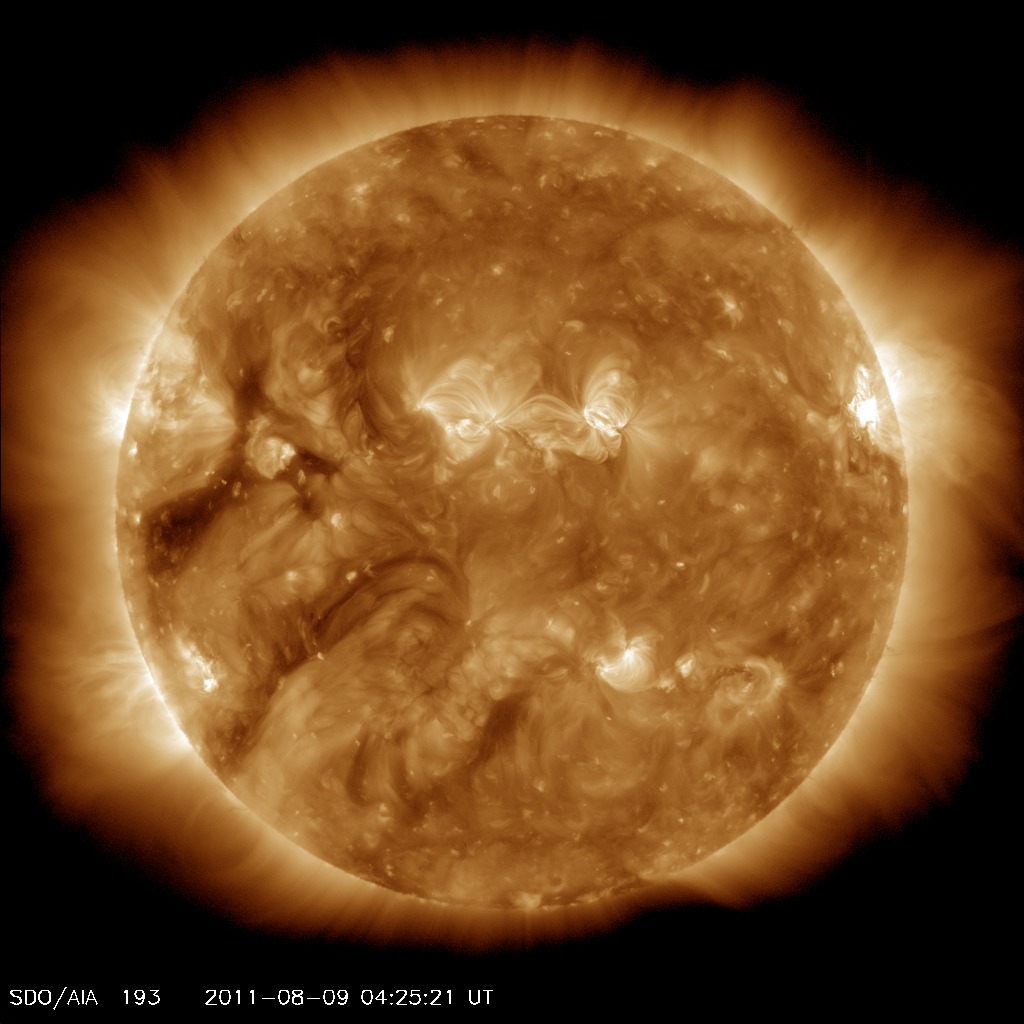
Coronal Holes: 09 Aug 11

A new coronal hole is emerging over the sun's east limb. Credit: SDO/AIA.
http://www.spaceweather.com/images2011/09aug11/coronalhole_sdo_blank.jpg?PHPSESSID=aev27sc47ralmecpei4crspil4
M-CLASS SOLAR FLARE: Sunspot 1263 produced an impulsive M3-class solar flare on August 8th at 1810 UT. In Falmouth, Maine, amateur astronomer John Stetson happened to be observing the sun and he caught the sunspot in mid-eruption:
http://www.spaceweather.com/
"Perhaps we will get some more auroras this week," Stetson wrote hopefully. Alas, no. Although this eruption did hurl a CME into space, the plasma cloud does not appear to be heading for Earth. Further analysis could reverse this conclusion, however, so stay tuned for updates.
more images: from Andreas v. Rétyi of Coburg, Germany; from Dave Gradwell of Birr Ireland; from SDO in Earth orbit
WEEKEND AURORAS: A widespread display of auroras erupted late Friday, Aug. 5th, when a double-CME hit Earth's magnetic field and sparked a G4-category geomagnetic storm. Click on the image to view a time lapse video of the event recorded by Michael Ericsson on the shores of Tibbitt Lake in the Northwest Territories of Canada:
"Although not the most intense auroras I've ever seen, this one is definitely up there on my favorites list," he says.
The show was not restricted to Canada. Northern Lights spilled across the border into the United States as far south as Oregon, Utah, Colorado, and Nebraska. (Note: The faint red lights photographed in Nebraska are typical of low-latitude auroras during major geomagnetic storms.) Observers in Europe as far south as England, Germany and Poland also witnessed a fine display. Browse the gallery for more examples.
Did you miss the show? Don't let that happen again. Sign up for geomagnetic storm alerts: text, voice.